
Indonesia's History of Gold
Brief History
Gold was first discovered as shining, yellow nuggets. As the saying goes, “Gold is where you find it,” and in its natural state, gold was first discovered in streams across the world. Without a doubt, it was the first metal known to early hominids.
Gold was also the first metal widely recognized by our species. While the historical progress of technology often highlights the development of iron and copper as major advancements in economic and cultural evolution, gold came first.
The “Gold of Troy” treasure hoard, excavated in Turkey and dating back to 2450–2600 B.C., showcases a wide range of gold artifacts, from delicate jewelry to a gold gravy boat weighing a full troy pound. During this era, gold was highly valued but had not yet evolved into a form of currency. Instead, it was owned by the elite and influential, crafted into objects of worship, or used to adorn sacred places.
In ancient times, civilizations such as the Phoenicians, Egyptians, Indians, Hittites, and Chinese pursued gold with great ambition. Prisoners of war, slaves, and criminals were often forced to work in gold mines, despite gold not yet being considered “money” but rather a highly desirable commodity.
Gold History in Nusantara
Srivijaya Era
During the Srivijaya period, Sumatra was known as “Swarna Dwipa,” which translates to “Golden Island,” due to its abundant gold resources. The wealth of gold contributed significantly to the prosperity of the Malay Kingdom, making it a prime target for conquest. Srivijaya successfully dominated the Malay Kingdom, further enriching itself with its golden treasures.
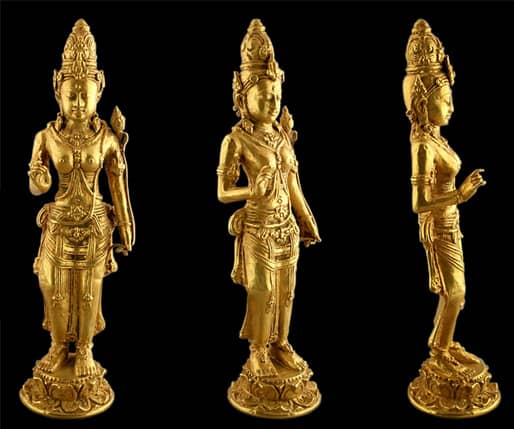
Various gold artifacts have been discovered in Rantaukapastuo, Muarabulian, and Jambi, including the Avalokiteśvara gold statue in the Malay-Srivijaya style, along with numerous other relics crafted from gold.
Ancient Mataram Kingdom Era
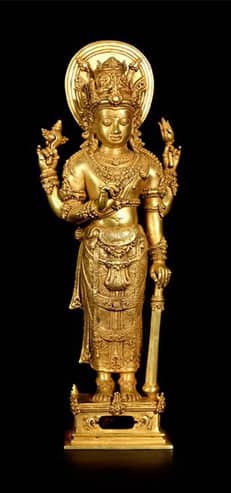
During the Ancient Mataram Kingdom, gold symbolized prosperity and royal power. Archaeological findings in Prambanan, Klaten, include royal relics such as golden crowns and ornaments.
Additionally, in August 2010, the theft of a valuable collection of Ancient Mataram gold jewelry from the Sonobudoyo Museum in Yogyakarta shocked historians and the public alike.
Aside from gold artifacts, the Ancient Mataram Kingdom also issued gold coins around 850–860 AD, which included:
- Masa (Ma): 2.40 grams
- Atak: 1.20 grams
- Kupang (Ku): 0.60 grams
- ½ Kupang: 0.30 grams
- Saga: 0.119 grams
Majapahit Era
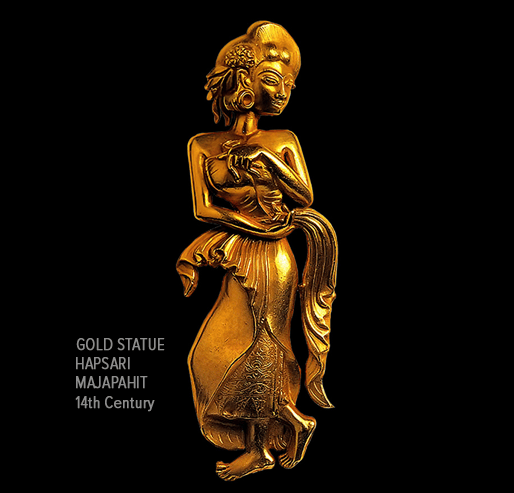
Majapahit was one of the largest and most powerful kingdoms in the Indonesian archipelago. According to Kakawin Nagarakretagama (1365), written by Mpu Prapanca, the kingdom’s territory extended over Java, Sumatra, the Malay Peninsula, Borneo, Sulawesi, the southern Philippines, Maluku, Nusa Tenggara, and Papua.
An Italian traveler, Mattiussi, recorded his impressions of Majapahit in his book The Journey of the Pastor Odorico da Pordenone. He described the Majapahit king’s palace as luxurious and awe-inspiring, with walls covered in gold.
During this era, in addition to the use of Kepeng coins, gold coins began circulating in large quantities. Archaeological findings at Majapahit sites reveal numerous gold currencies, primarily in the form of “Ma” (short for māsa), inscribed in Nagari or Old Javanese script. Other gold coins were denominated in tahil units, marked with the “ta” inscription. These coins typically weighed between 2.4 – 2.5 grams.
The Negarakretagama also mentions that during royal processions, the king’s convoy was decorated with gold jewelry. At state banquets and grand celebrations, golden utensils adorned with precious gemstones were used. According to legend, after a lavish feast, golden dining utensils were thrown into the Segaran Pool, a royal bathing area originally reserved for the king’s concubines.
Indonesia's Gold Mining History
The history of gold mining in Indonesia dates back to traditional community-based mining activities, which were conducted with the permission of local rulers such as kings and sultans. When the Dutch East India Company (VOC) was established, it took control of the mining trade and later formed the Dienst van het Mijnwezen (Mining Service) to regulate the industry.
By the 20th century, large-scale gold exploitation by the Dutch East Indies government intensified. Several major multinational mining companies were established, including:
- Royal Dutch – Oil mining in Pangkalan Brandan, North Sumatra
- Billiton Maatschappij – Tin mining in Belitung
- Mijnbouw Maatschappij van Zuid Bantam – Gold mining in Cikotok, Banten
- Bataafsche Petroleum Maatschappij – Oil mining in Balikpapan
- Nederlandsche Nieuw Guinea Petroleum Maatschappij – Oil mining in Papua
Today, Indonesia contributes approximately four percent of global gold production, with half of it coming from the Grasberg mine in Papua, the largest gold mine in the world. This mine, which holds an estimated 67.4 million ounces of gold reserves, is primarily owned by the American company Freeport-McMoRan Copper & Gold Inc. and is the largest taxpayer to the Indonesian government.
However, operations at Grasberg have been marred by conflict. Since the Reformasi era, the mine has been plagued by violence, sabotage, and armed attacks, including assassinations and robberies. The underlying causes of this unrest include:
- The Free Papua Movement’s struggle for independence
- Resentment toward foreign control over Indonesia’s natural resources
- Papua’s high poverty rate, which exacerbates social tensions
These persistent issues have caused periodic production disruptions in the past and are likely to continue affecting the mine’s operations in the future.